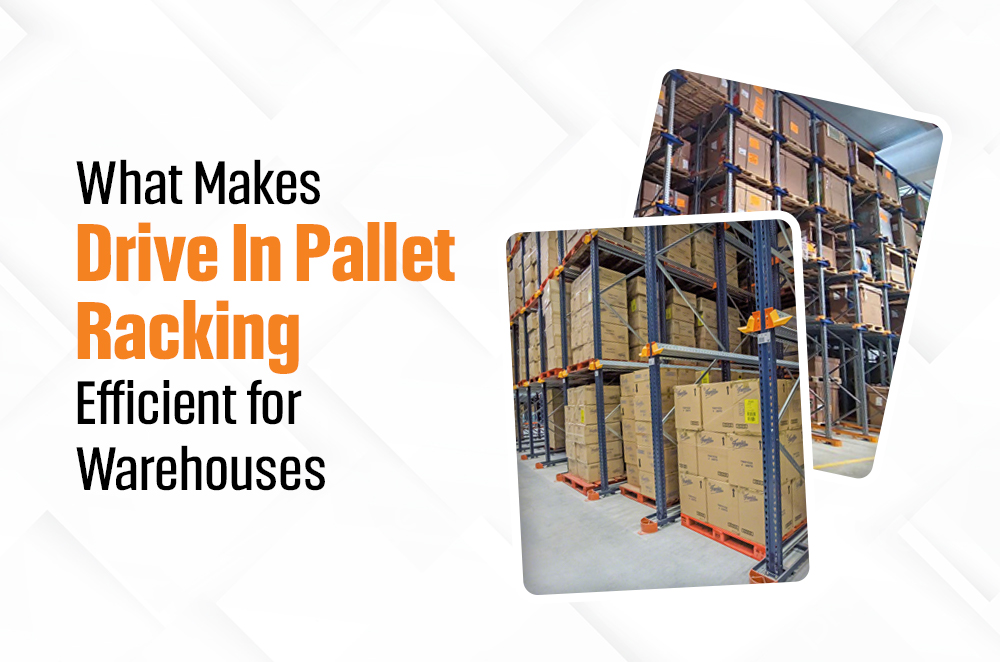
Drive in pallet racking has a high-volume storage capacity that is maximizing the warehouse space by eliminating the need for aisles. It is designed with specialized guide rails where the goods can be stored. The common applications are warehouses, distribution centers and cold storage facilities. It typically optimizes the space and improves inventory turnover. In this blog, we’ll explore the nature of drive in pallet racking, working principles and benefits. Additionally, we’ll touch its components, necessary safety considerations and supplier selection. Ultimately, this guide aims to provide useful insights for the organization to find the ideal warehouse racking and shelving solution.
Advantages of Drive In Pallet Racking
 1. Maximum Use of Available Space
By stacking pallets several positions deep and multiple levels high, businesses can store a high volume of goods in a compact footprint. This is especially useful for operations working within space-constrained warehouses or cold storage facilities where every square meter is valuable. Compared to conventional selective racking, drive in racking can increase storage capacity by up to 85%, making it a smart choice for businesses with large quantities of homogeneous products. This high-density solution improves overall warehouse efficiency and makes it easier to manage bulk inventory without compromising safety or accessibility. For facilities aiming to boost storage without relocating, this system is a strategic investment.
2. Ideal for Storing Similar Products
Warehouses that handle high quantities of the same product type benefit greatly from drive in pallet racking. It uses a LIFO system of inventory management, which prioritizes retrieval of most recently stored goods. Companies that store construction supplies, frozen meals, or seasonal inventory, all of which are homogenous and do not require tight date rotation, will find this arrangement to be excellent.
Improved operational flow is possible with drive in racking since there are fewer stock-keeping units to keep track of, which speeds up loading and unloading. The technology lessens the likelihood of product damage while also minimizing handling time and facilitating predictable, repeating motions for warehouse workers.
3. Cost-Effective Storage Solution
It is a cheaper option than bigger automated systems or building bigger warehouses. Businesses may store more pallets without taking up additional room by making the most of both vertical and horizontal space. The structure itself is simple and doesn’t need as many parts or as much time to install as multi-aisle racking systems. Also, less aisle space means that each pallet needs less lighting and HVAC, which lowers operating costs even more.
The strong, heavy-duty construction of racking frames also makes maintenance cheaper. Drive in racks are great for cold storage facilities or seasonal stockpiles because they make better use of space and increase worker productivity, which saves money over time. It is a reliable option that works well over time since it is strong and easy to use. Drive in pallet racking is a good way for businesses to get more out of existing storage space without having to buy more land or automate their operations.

4. Enhances Workflow and Inventory Turnover
Drive in pallet racking is mostly used for storing large amounts of goods, but it may also aid with rapid inventory turnover provided the right operational setup is in place. The method is designed to swiftly move objects in and out, especially when moving complete pallets of the same sort of item. Forklift drivers can go to a number of pallets in one lane without having to transfer aisles, which saves a lot of time. This reduces down on the number of trips and hours required needed to get and put things away.
The drive in approach makes it simpler for workers to reach pallets in crowded storage areas. This is helpful for industries like dairy, drinks, and packaged goods where rapid turnaround is vital. If you maintain track of your inventory correctly, it may move fast and efficiently, especially if the products that come in and leave out follow the same patterns. This method also keeps the floor of the warehouse from being too congested, which makes things safer and more orderly. This method can assist companies that need a regular supply of goods operate their enterprises considerably more smoothly.
5. Flexibility for Seasonal and Overflow Stock
Drive in pallet racking is quite flexible, which makes it great for dealing with seasonal inventory increases or extra stock. Its high-density design lets firms easily increase their storage space without having to change the layout of their current warehouse. These racks can hold a lot of the same items without needing to be expanded during busy times when storage needs are high. When the peak time is over, the racking system might be utilized more carefully or for different types of goods.
Drive in racking is a popular choice for retail, agriculture, and FMCG industries since they commonly have stock levels that change. It can also be used as a place to store shipments that are coming in or going out late. The flexibility to change utilization levels based on current demand helps make the most of warehouse space and makes it easier to move goods throughout the year. Drive in pallet racking is a useful and future-proof alternative for firms that need a flexible, expandable way to store things that come in different amounts.
Applications of Drive In Pallet Racking
1. Cold Storage and Freezer Warehouses
Drive in pallet racking is quite common in cold storage and freezer facilities, where space and temperature control are very important. Because refrigeration is so expensive, every square meter must be used wisely in these places. Drive in racking lets you store a lot of the same type of commodities on pallets, such frozen meals, dairy products, and meat. These types of goods typically need to be stored in bulk under the same circumstances.
2. Beverage and Bottling Facilities
The beverage business has a lot of the same kinds of items, which are usually stocked on conventional pallets. Drive in pallet racking is perfect for this industry since it lets you store a lot of soft drinks, bottled water, juices, or alcoholic drinks in a small, neat space. The Last-In, First-Out (LIFO) system is appropriate for managing these items because they don’t normally need to be rotated often.
3. Food and FMCG Warehouses
Packaged food and fast-moving consumer goods (FMCG) generally need to be stored in large quantities and be easy to get to when they need to be sent out. This business is a fantastic fit for drive in pallet racking, especially when it comes to organizing large amounts of snacks, canned products, and packaged dry meals. These items normally last a long time and come in uniform packaging, which makes them great for storage that isn’t going to change. Drive in racks let food distributors keep big amounts of the same SKU together, which makes picking faster and the warehouse more organized.
Conclusion
At BPI Racks, UAE, we understand that efficient warehouse storage is the backbone of operational success. Our drive in pallet racking solutions are designed to help businesses maximize their available space while reducing costs and streamlining inventory handling. Ideal for storing large volumes of similar products, this system eliminates the need for multiple aisles and makes use of every inch—both vertically and horizontally. It’s particularly effective for industries such as cold storage, food and beverage, and manufacturing, where high-density, secure, and reliable storage is essential.
Built with durability and precision, our drive in pallet racking offers Last-In, First-Out (LIFO) access, simplifying stock rotation for low-turnover goods. The robust structure enhances safety while reducing forklift travel time, improving your overall warehouse efficiency. Whether you’re dealing with seasonal overflow or daily bulk storage, BPI Racks delivers solutions that are both scalable and future-ready.